In the fading twilight of the American frontier, a man named Arthur Morgan coughed into his hand, the bloodstained kerchief a grim testament to a life slipping through his fingers like desert sand. Red Dead Redemption 2, a narrative colossus from Rockstar Games, is not merely a game about outlaws and gunfights; it is a profound meditation on mortality, legacy, and the desperate, often futile, human struggle against the currents of a changing world. As the year 2026 marks nearly a decade since its release, the story of Arthur Morgan and the Van der Linde gang continues to resonate, its themes of redemption and cyclical violence feeling more poignant than ever in a modern context. The tale serves as a sprawling prequel, meticulously laying the tragic groundwork for the events of the first Red Dead Redemption, creating a narrative tapestry where every thread of hope is woven with strands of inevitable doom.
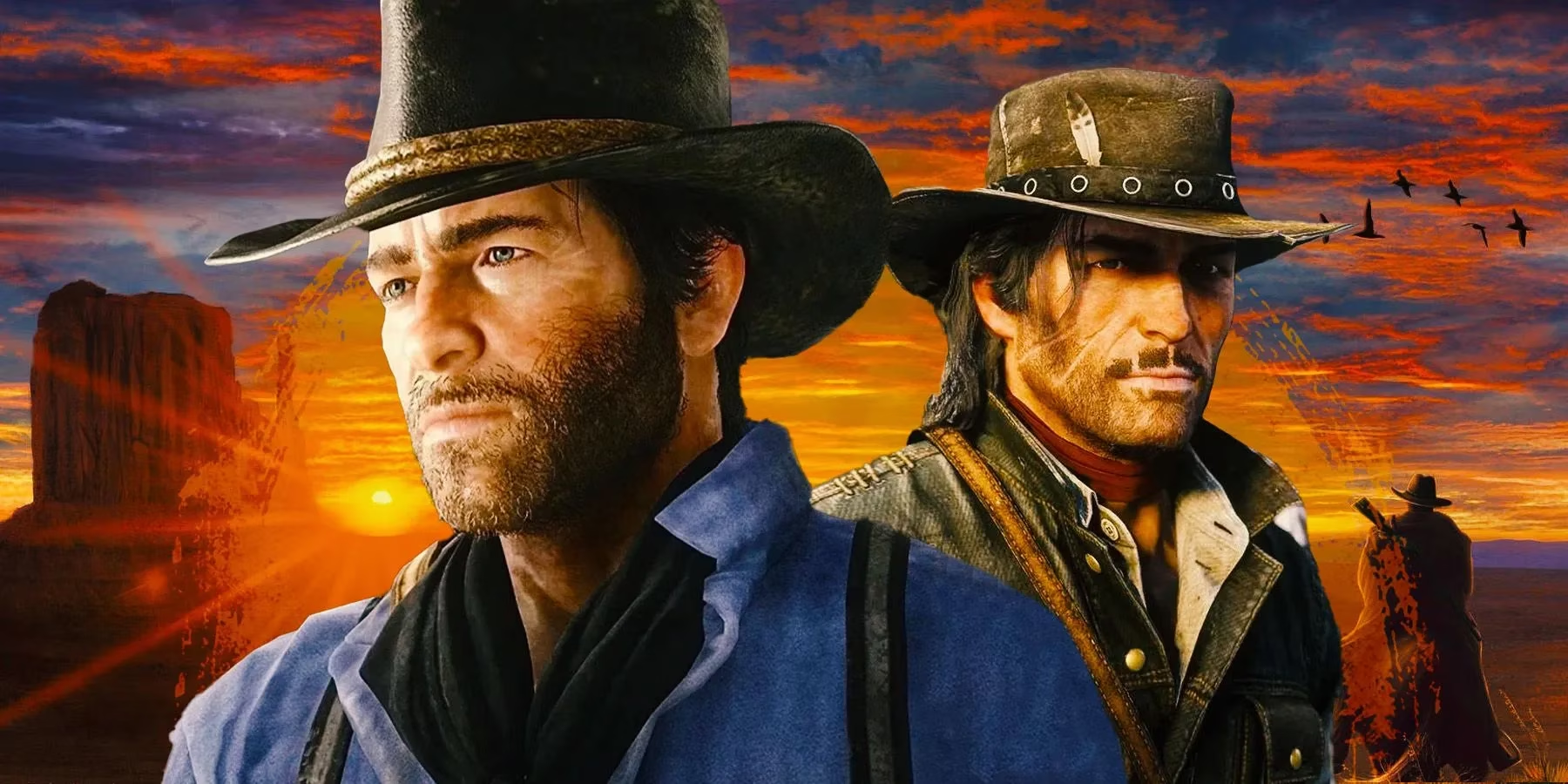
The Slow Unraveling: A Gang and a Man
The core of RDR2's narrative is a dual decay, a symphony of ruin played in two movements. The first is the disintegration of the Van der Linde gang, a found family of outlaws led by the charismatic yet increasingly delusional Dutch van der Linde. The second, and more intimate, is the physical and spiritual deterioration of Arthur Morgan himself, stricken with a terminal case of tuberculosis. This disease acts as the story's relentless metronome, ticking down the remaining moments of a life spent in violence. The gang's collapse is accelerated by the serpent in their midst, Micah Bell, whose manipulations drive a wedge between Dutch and his most loyal son, Arthur. As the gang fractures, Arthur is left grappling with his legacy, caught between his brutal past and the fleeting glimpses of a better man he could have been. The player's choices throughout the epic journey—acts of kindness or cruelty—sculpt Arthur's honor, ultimately determining the tenor of his final days.
The Final Confrontation: Choices at Dawn
The story crescendos in a masterfully bleak finale. After John Marston is left for dead and Arthur uncovers Micah's ultimate betrayal to the law, a final confrontation erupts. Arthur faces his surrogate father, Dutch, only to be abandoned once more. Weakened and dying, Arthur is presented with a final, defining choice: help John escape to his family or go back for the gang's stash of money. This moment is the crucible where a player's entire journey is tested.
-
The Low-Honor Path: An Arthur who embraced villainy meets a fittingly brutal end, slain by Micah in a bitter, ugly struggle. It's an ending devoid of grace, a life of selfishness culminating in a meaningless death.
-
The High-Honor Path: Here, Arthur's journey achieves a tragic nobility. He helps John escape, confronts Dutch with the truth about Micah, and finally succumbs to his illness while watching the sunrise—a man who, against all odds, found a sliver of redemption. His last act is not for himself, but for the future of another.
Regardless of the path, the outcome is tragically fixed: John escapes, Micah vanishes with the money, and Arthur Morgan dies on that mountainside. His story ends, but the cycle is far from complete.
The Epilogue: A Peaceful Interlude Before the Storm
The game then transitions to an epilogue set seven years later, allowing players to step into the boots of John Marston. This section is a deliberate tonal shift, a pastoral calm after the hurricane of Arthur's demise. John, now a family man, attempts to build a peaceful life: constructing a home, ranching, and reconnecting with old friends like Charles Smith and Sadie Adler. It's a life Arthur desperately wanted for him. Yet, this peace is as fragile as a spider's web in a storm. The ghost of the past, in the form of Micah Bell, cannot remain buried. Driven by a need for closure and vengeance for Arthur, John, Abigail, and Sadie track down the traitor. In a final, cathartic gunfight, John puts a bullet in Micah, finally laying one ghost to rest.
| Character | Role in the Cycle | Ultimate Fate |
|---|---|---|
| Arthur Morgan | The Seeker of Redemption | Dies from illness, having secured John's escape. |
| John Marston | The Inheritor of the Legacy | Kills Micah, but is later killed by Edgar Ross. |
| Micah Bell | The Agent of Chaos | Killed by John Marston for his betrayals. |
| Dutch van der Linde | The Broken Idealist | Descends into madness, his gang and ideals shattered. |
| Edgar Ross | The "Civilized" Predator | Exploits the chaos, ultimately killed by Jack Marston. |
The Heartbreaking Symmetry: Arthur, John, and the Inescapable Cycle
The true genius of RDR2's ending lies in its devastating dramatic irony, especially for those who played the original 2010 game. Arthur's entire journey is a mirror held up to a future he will never see, reflecting John's own doomed path. Arthur sacrifices himself to give John a chance at a new life, free from the gang. Yet, John's act of vengeance—killing Micah—is the very thing that draws the attention of the corrupt federal agent Edgar Ross. This single violent act, though justified, is like dropping a stone into a still pond; the ripples of consequence spread outward, unstoppable. It sets in motion the events of the first Red Dead Redemption, where Ross blackmails John into hunting his former gang, only to betray and murder him afterward.
Arthur's redemption is thus bittersweet and incomplete. He saved John's life, but he could not save John from himself or from the world that was closing in on men like them. The West was becoming a gilded cage of laws and railroads, and outlaws had no place in it. John's son, Jack, witnessing his father's murder, later picks up a gun and kills Ross, avenging his father but also stepping into the very cycle of violence John and Arthur had desperately tried to break. It is a conclusion that feels less like victory and more like a tragic, inherited script being read by a new generation.
Legacy in 2026: Why the Story Endures
Nearly ten years on, the narrative of Red Dead Redemption 2 stands as a landmark in interactive storytelling. Its power derives from its unflinching tragedy and its profound themes. It argues that while the past is a shadow that clings to a man's heels long after the sun has set, the struggle to be better still has meaning. Arthur Morgan's final journey, whether honorable or dishonorable, is a testament to the human capacity for change, even in the face of certain doom. The game masterfully uses its prequel status not to provide simple answers, but to deepen the tragedy, showing how good intentions and desperate acts can weave the very noose that history will use. In the end, Red Dead Redemption 2 is a beautiful, heartbreaking ode to the last outlaws of a dying age, men who raced against a sunset that was always going to overtake them.