I still remember August 2024 like it was yesterday. The summer had cooked my brain to a fine paste, and the only thing capable of pulling me out of a gaming rut was the promise of a monkey king with a staff that could grow to the size of a suburban telephone pole. Black Myth: Wukong didn’t just arrive—it crashed through the wall like a Yaoguai who’d missed anger management class. Two years later, in 2026, the dust has settled, the patches have patched, and the PS5 version no longer sounds like a jet engine preparing for liftoff. I’ve recently returned to that mythic, frustrating, and utterly bewitching world, and I can confirm: it’s still the most beautiful chaos I’ve ever wielded a gourd in.

Let’s rip the bandage off first: Black Myth: Wukong is not a flawless masterpiece. It never was, and it probably never will be. If you go in expecting a seamless open-world pilgrimage like Elden Ring, you’ll feel like you’ve been tricked into a banquet where only the main courses are served and the side dishes are invisible. The game is a boss rush disguised as an action-RPG. Between those towering, screen-filling monstrosities, the levels often feel like walking through a breathtaking museum where someone forgot to install the exhibits. Richard Wakeling, in his review back in the day, called it “aimless tedium,” and I can’t improve on that phrase. I’d just add that it’s a tedium so polished you can see your bewildered face in the floor textures.
And yet, like a moth who’s developed a taste for flame because it’s just so pretty, I kept pushing forward. The combat is the reason. Imagine trying to juggle flaming torches while reciting a poem in a language you’re still learning—that’s the sweet spot Game Science found. Every fight asks you to dance between resource management and twitch reflexes, where a single missed dodge can turn you into a red smear on an ancient temple wall. The stances, the spells, the transformations—they’re like a toolbox handed to you by a prankster god. You learn to freeze an enemy mid-lunge, then turn into a massive rock creature and squash them like a stress toy. It never gets old, even when you’ve died for the fifteenth time to a wolf boss who clearly trained under a UFC champion (I’m looking at you, Guangzhi).
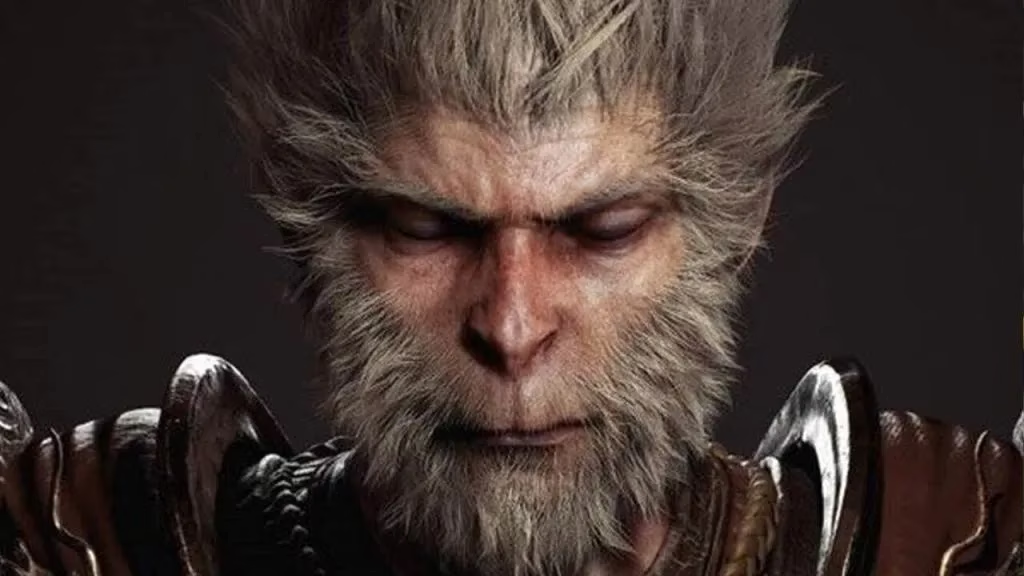
What sets Wukong apart from the pack of soulslikes that have multiplied like rabbits in a carrot factory is its sheer theatricality. Every boss fight feels like the climax of a Peking opera directed by someone who just discovered pyrotechnics. The sky cracks, the earth trembles, the music swells—and then the boss pulls out a second health bar and you laugh-sob into your controller. It’s a game that understands spectacle is a language all its own. Tyler Colp once joked about getting “jumped by another animal who learned MMA,” and that never stops being true. From a lightning-wielding dragon to a drunken boar with a grudge, the bestiary reads like a fever dream co-written by Sun Wukong and a martial arts choreographer.
Narratively, the game is a silk tapestry woven by a hyperactive spider. Threads connect, but you spend half the time untangling them with your teeth. If you haven’t brushed up on Journey to the West, you’ll feel like you’ve walked into a play during the third act. Yet that confusion is almost the point. The game encourages you to lean into the strangeness, to embrace the fact that you’re a mythological figure in a world where logic wears a crooked smile. I found myself caring deeply about side characters who looked like discarded Muppets and spoke in riddles. Jason Rodriguez called it “a journey written centuries ago that has stood the test of time,” and once you settle into its rhythm, you realize he’s right. It’s not about understanding every beat—it’s about trusting the storyteller to make the ending worth the bruises.
In 2026, technical hiccups that plagued the launch window have mostly been ironed out. I originally played on PC, where my GPU fans screamed like a banshee during certain cutscenes, but now the experience is smoother than a freshly waxed floor. The PS5 version, once a frame-drop fiesta, now holds its own—though I’d still recommend performance mode for those who prefer their monkey kings without slideshow interludes. The English localization, too, has been given a much-needed polish. Characters no longer sound like they’re reading fortune cookie messages through a tin can; the wit and gravity of the original writing finally shine.
So, is Black Myth: Wukong worth your time in 2026? Absolutely, if you can accept a game that’s built like a sandwich where the bread is dry but the fillings are celestial ambrosia. It stumbles during the quiet moments, trading exploration for empty corridors, but when it roars to life, it’s unlike anything else. I’d argue it’s the gaming equivalent of a fireworks display held inside a cathedral—messy, overwhelming, and impossible to look away from. Two years haven’t smoothed its edges into oblivion, but they’ve revealed a title confident in its own strange skin. I still unscrew my gourd, take a sip, and dive back in, grinning like a fool, because only a fool would miss a dance this chaotic and beautiful.